ClimbMill vs Stepper: Movement, Intensity, Space & Buying Guide in Kuwait
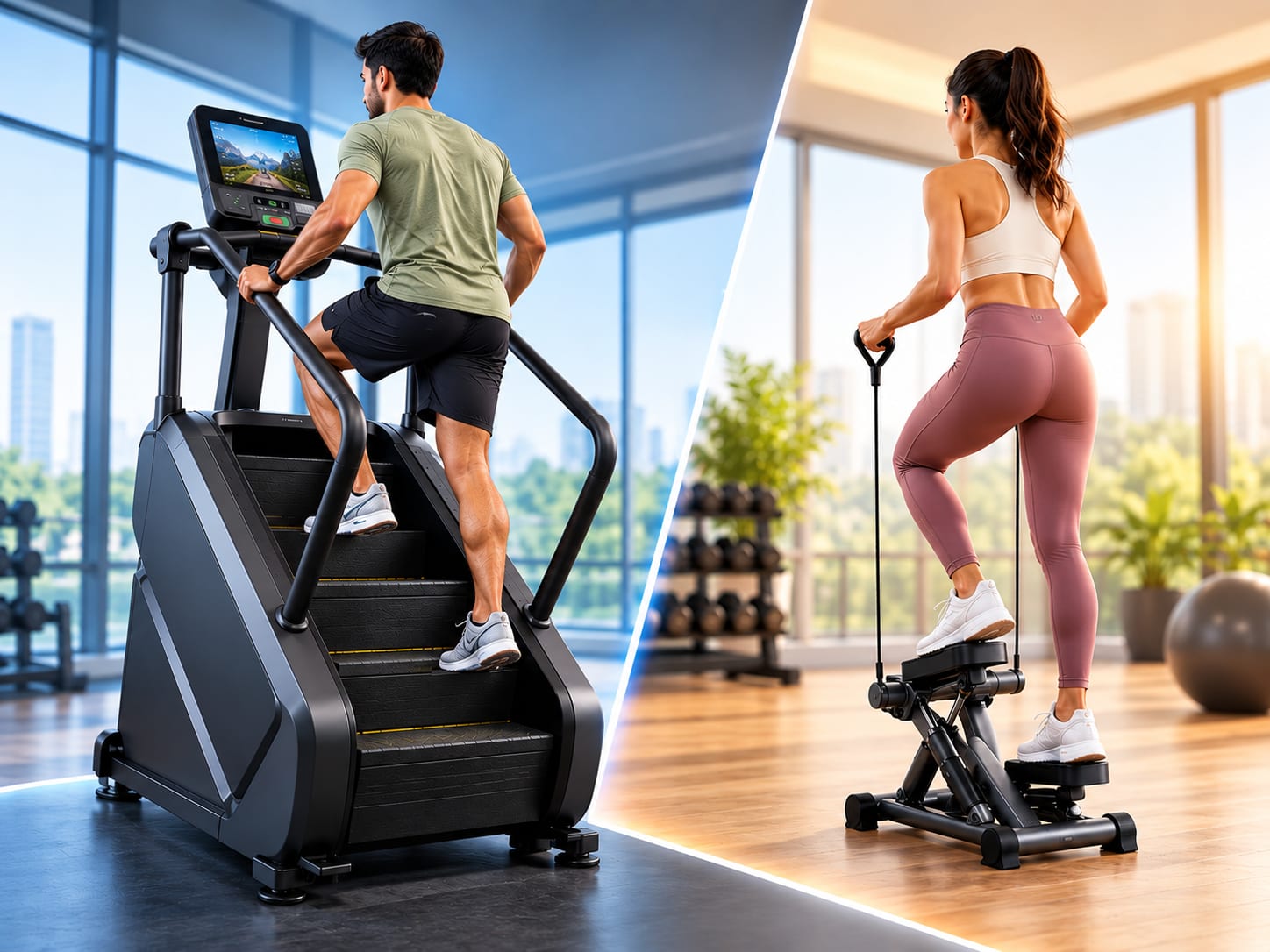
The importance of choosing the right cardio machine needs no introduction. It makes a big difference to your workout experience. If you are setting up a home gym, upgrading a commercial gym, or planning to build a fitness centre, you may have come across two options: the ClimbMill and the Stepper.
Both machines are designed to enable stair climbing and improve cardiovascular fitness. They also support lower-body training and calorie-burning workouts. Interestingly, they are not the same. Their movement patterns, workout intensity, and space requirements vary for different users.
Needless to say, this will leave many in a dilemma. In this blog, we compare the ClimbMill and Stepper and explain how each machine works, what to look for before buying, and which option may suit your fitness requirements and space.
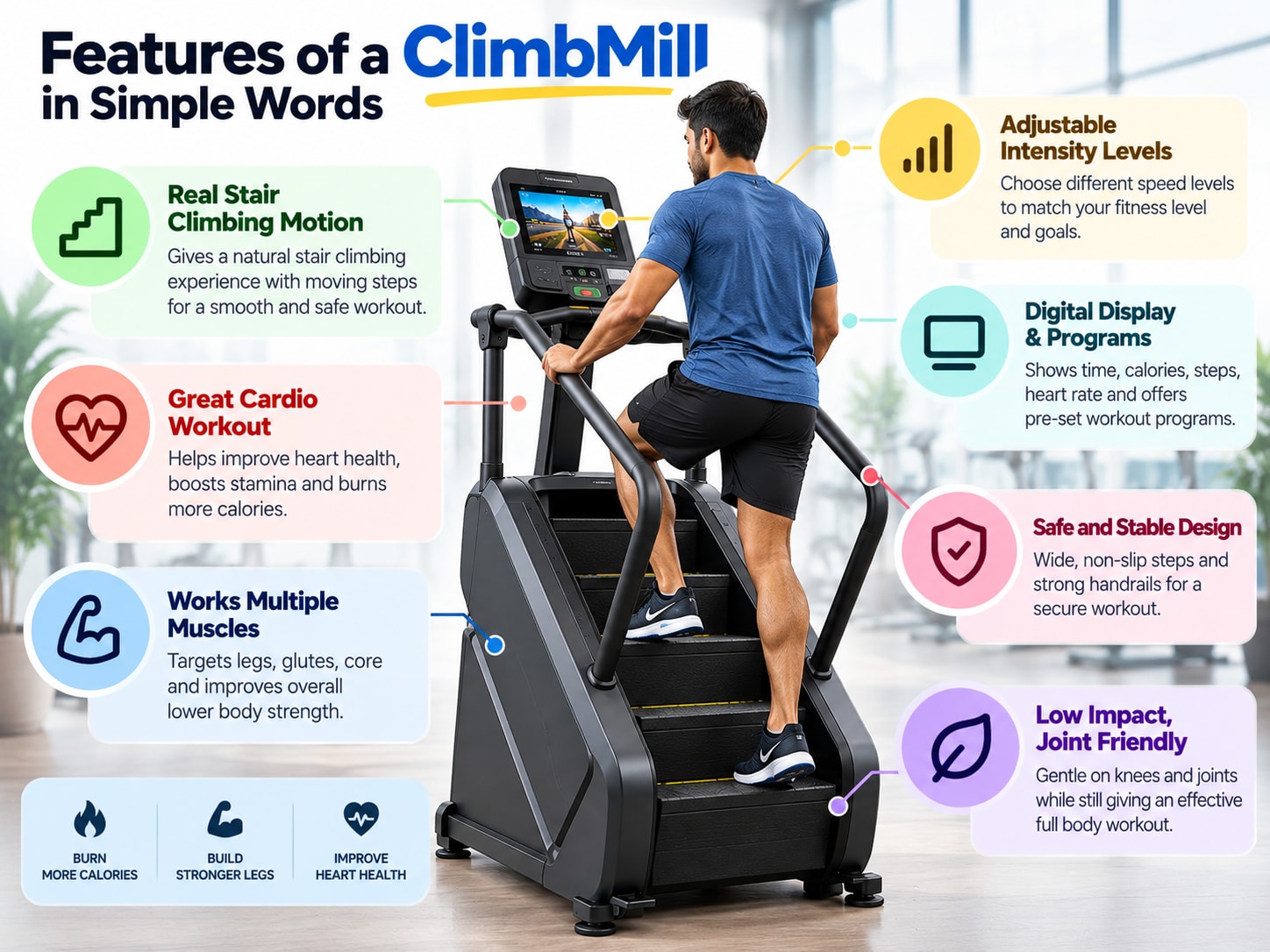
Features of a ClimbMill in Simple Words
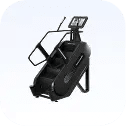
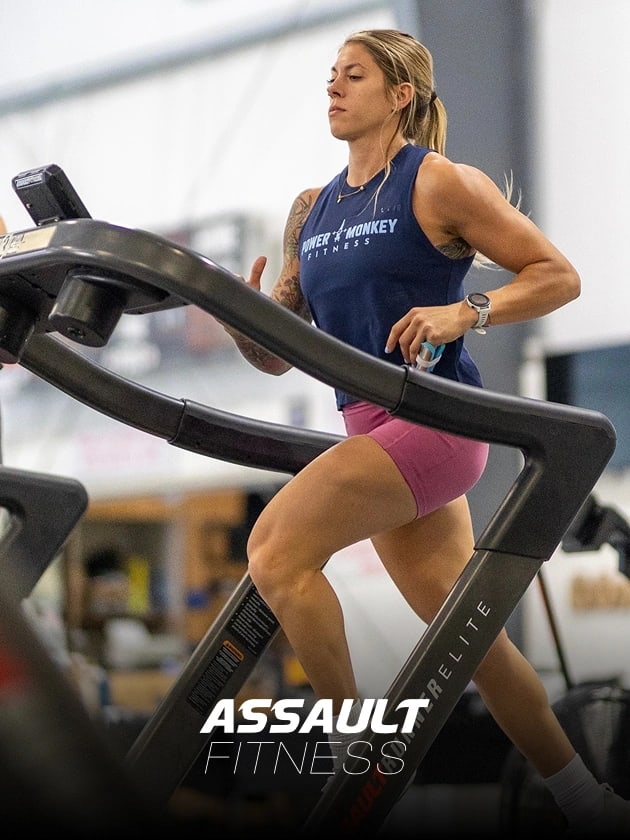
A ClimbMill is a cardio machine with a continuously rotating set of steps. As you climb, the steps move downwards, creating a steady stair-climbing motion. You need to keep stepping to maintain your workout momentum.
Unlike a regular treadmill, a ClimbMill focuses on vertical movement rather than forward running or walking. This makes it beneficial for people who crave for a challenging cardio session with plenty of lower-body involvement.
ClimbMills are commonly found in commercial gyms, premium fitness clubs, and larger training facilities. They are often used for endurance training, high-intensity cardio sessions, and lower-body conditioning.
Depending on the model, a ClimbMill may offer adjustable climbing speeds, workout programmes, a digital console, heart-rate monitoring, and handrails for support.
Key benefits of a ClimbMill
Provides a continuous stair-climbing workout.
Allows users to adjust the climbing speed on many models.
Engages the quadriceps, glutes, calves, and hamstrings.
Can provide a demanding cardiovascular workout.
Suits commercial gyms and dedicated cardio zones.
A ClimbMill is a good option in gyms that offer members a more challenging alternative to traditional cardio machines.
Features of a Stepper in Simple Words
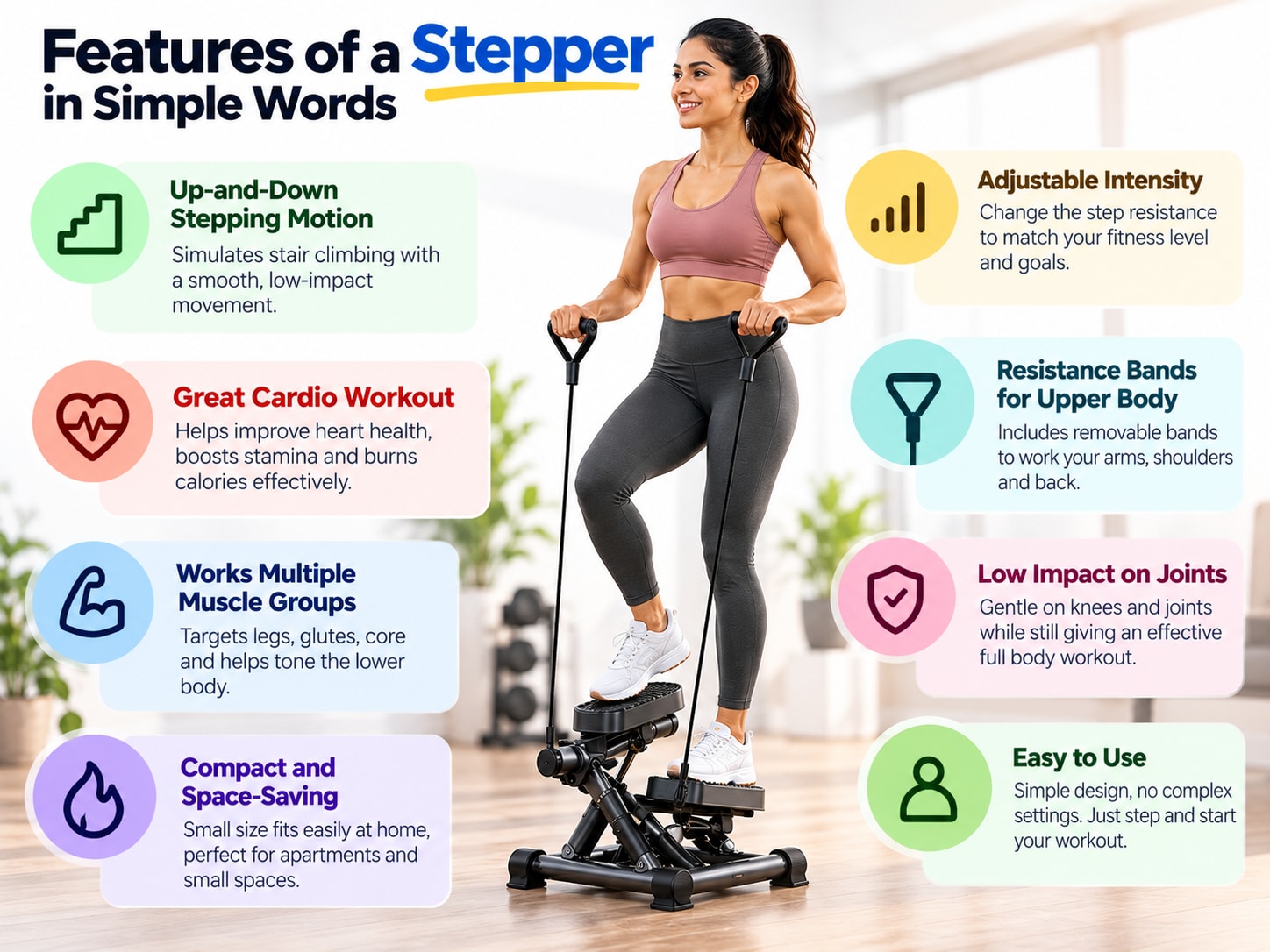
A stepper is a cardio machine that simulates the movement of climbing stairs. However, the exact movement depends on the type of stepper.
Some models have two pedals that move up and down, while others use larger steps or a rotating stair mechanism. Compact stepper machines are usually designed for smaller workout areas, while commercial stair-climbing machines may be larger and more advanced.
A basic stepper allows users to repeat a stepping motion without moving forward. Resistance and step height may vary by model. Some machines offer adjustable resistance, while others have limited settings. Steppers are available for home gyms, personal studios, apartment fitness rooms, and commercial gyms.
Key benefits of a stepper
Simulates stair climbing in a compact format on many models.
Can support cardiovascular fitness and lower-body conditioning.
Offers options for beginners and experienced users, depending on the design.
May take up less space than a commercial ClimbMill.
Can be suitable for home workouts and smaller fitness facilities.
Before buying a stepper, check whether it is a compact pedal-style model, a commercial stair climber, or another type of stepping machine. These designs can have very different features and space requirements.
ClimbMill vs Stepper: Understanding the Movement Pattern
The main difference between a ClimbMill and many traditional steppers is how the steps move. A ClimbMill uses a continuous staircase. The steps move in a loop, and users climb one step after another. This creates a movement pattern similar to walking up a long flight of stairs.
Many compact steppers use two separate pedals that move up and down. The user alternates between the left and right foot, creating a repeated stepping motion without a continuously moving staircase. Both movements involve the lower body, but the workout experience can feel different.
ClimbMill movement
The continuous steps require users to maintain their rhythm as the machine moves. Users can usually adjust the speed to make the workout easier or more challenging. The movement is well suited to people who need a sustained stair-climbing experience. It can feel more demanding because users must keep pace with the moving steps.
Stepper movement
On a pedal-style stepper, users press down on each pedal against the machine's resistance. The movement is usually shorter and more controlled than climbing full-sized rotating steps.
Some users may find this style easier to fit into a short home workout. However, the experience depends on pedal travel, resistance settings, and the machine's stability.
Which movement is better?
Neither movement is considered automatically better for everyone. Choose a ClimbMill, if you want a continuous stair-climbing experience and have enough room for a larger cardio machine. A compact stepper may be a better fit, if you want a smaller machine for regular home workouts.
If you are purchasing a commercial gym, try to match the machine to your members' expectations. Some users prefer the familiar feel of a continuous staircase, while others may prefer a simpler stepping movement.
Workout Intensity: Which Machine Is More Challenging?
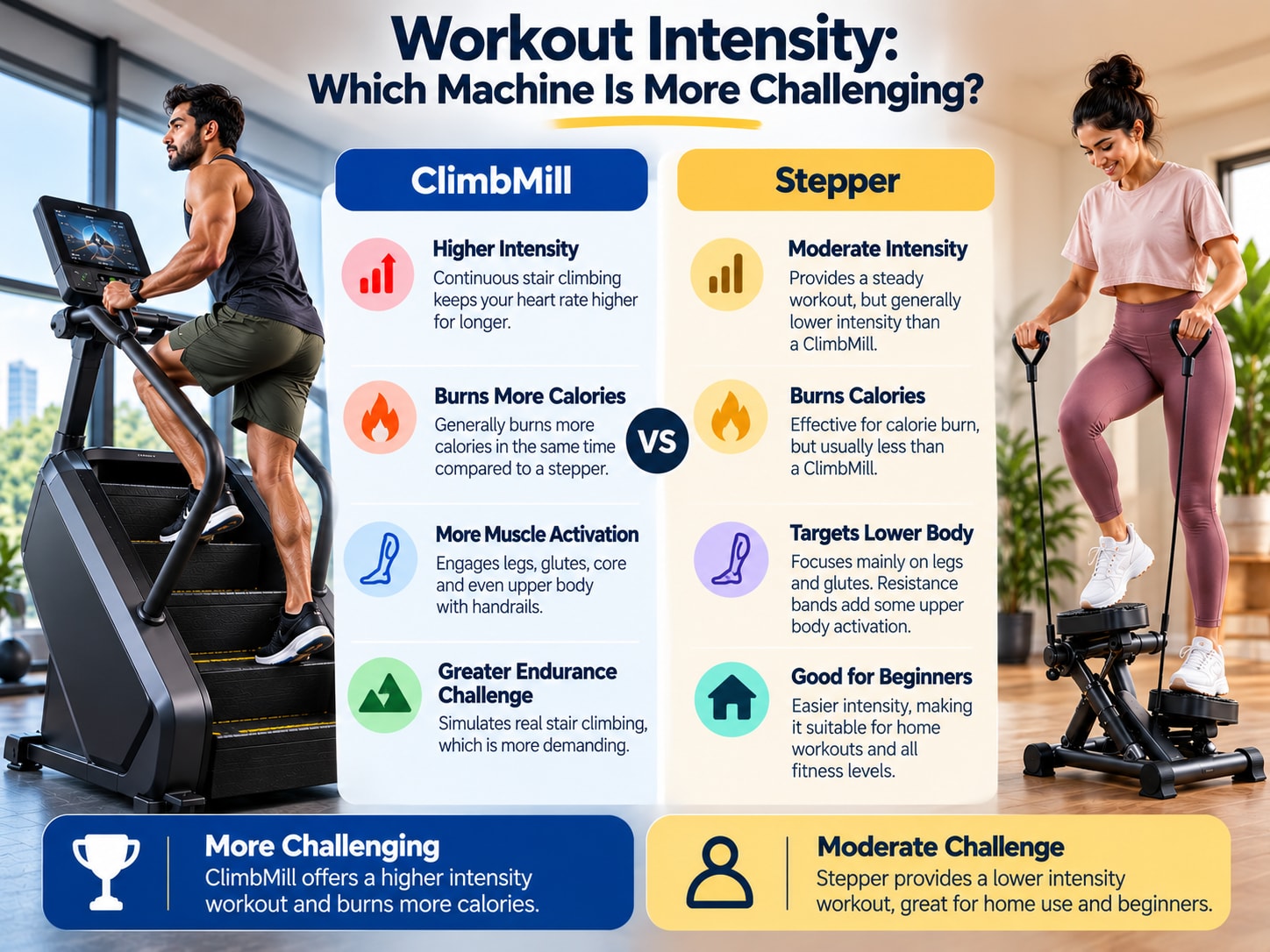
Workout intensity depends on several factors, including speed, resistance, workout duration, fitness level, and how much effort the user puts in.
A ClimbMill can provide a demanding workout because users continue climbing against a moving staircase. Increasing the speed can make the session more challenging and raise the cardiovascular demand.
A stepper can also provide an effective workout. On models with adjustable resistance, users can increase the effort needed for each step. The challenge will depend on the machine's design and available settings.
ClimbMill intensity
A ClimbMill is often chosen for challenging cardio sessions and endurance training. Faster climbing speeds can increase the workout demand, so beginners should start slowly and build up gradually.
The machine may also be useful for interval training, where users alternate between easier and harder periods. Follow the machine's instructions and choose a pace that allows you to maintain control.
Stepper intensity
A stepper can be used for steady cardio or more demanding sessions, depending on the model. Compact steppers may have simpler resistance options, while commercial models can provide a wider range of workout settings.
A higher resistance setting does not always mean the same thing across different machines. Compare the actual controls and movement before deciding which model offers the workout you need.
Which burns more calories?
There is no fixed answer. Calorie expenditure varies with body weight, workout duration, speed, resistance, and individual effort.
A challenging ClimbMill session may require more effort than a light session on a compact stepper. However, a vigorous stepper workout may be more demanding than a slow ClimbMill session. The best machine is one that matches your fitness level and encourages you to exercise consistently.
ClimbMill vs Stepper: Impact Gained on Muscles
Both machines predominantly focus on the lower body while also challenging the cardiovascular system. The main muscles involved include the following:
Quadriceps: Help straighten the knees during the stepping movement.
Glutes: Contribute to hip extension and help drive the body upwards.
Hamstrings: Assist with hip and knee movement.
Calves: Help control ankle movement and contribute to each step.
The level of muscle involvement depends on the machine's design, step height, resistance, posture, and workout technique. A ClimbMill may encourage a more continuous stair-climbing pattern, while a compact stepper may involve shorter pedal movements.
Neither machine should be treated as a complete replacement for strength training. If your goal is to build muscle, combine cardio workouts with a suitable resistance-training programme.
Footprint and Space Requirements for Cardio Equipment
Space is an important consideration when buying cardio equipment. Apartments, villas, personal training studios, hotels, and commercial gyms all have different layout requirements.
A ClimbMill is generally a larger machine than a compact pedal-style stepper. It needs space for the equipment itself, user access, safe mounting and dismounting, and clearance around moving parts.
A compact stepper may fit more easily into a home gym or a small exercise corner. However, commercial stair-climbing machines can also require considerable floor space, so do not assume that every stepper is small.
Space planning for a ClimbMill
Before purchasing, measure the available floor area and check the machine's full dimensions. Consider the following:
Width and length of the equipment.
Total height and ceiling clearance.
Space for users to get on and off safely.
Clearance around the machine for maintenance.
Distance from other cardio equipment and walkways.
Remember that the equipment footprint is not the same as the total area needed to use it comfortably.
Space planning for a Stepper
A compact stepper may be easier to accommodate in a home gym, bedroom workout area, or small personal training studio. It may also be easier to move or store if the specific model is designed for that purpose.
Check the machine's weight, stability, dimensions, and storage instructions before buying. Do not assume that every model can be folded or stored vertically.
Which is better for small spaces?
A compact stepper is considered the practical choice when floor space is limited. A ClimbMill may be more suitable when you have a dedicated cardio zone and want a larger stair-climbing machine. For apartments and villas, measure the room, doorways, lifts, and access corridors before ordering equipment. This helps avoid delivery and installation problems.
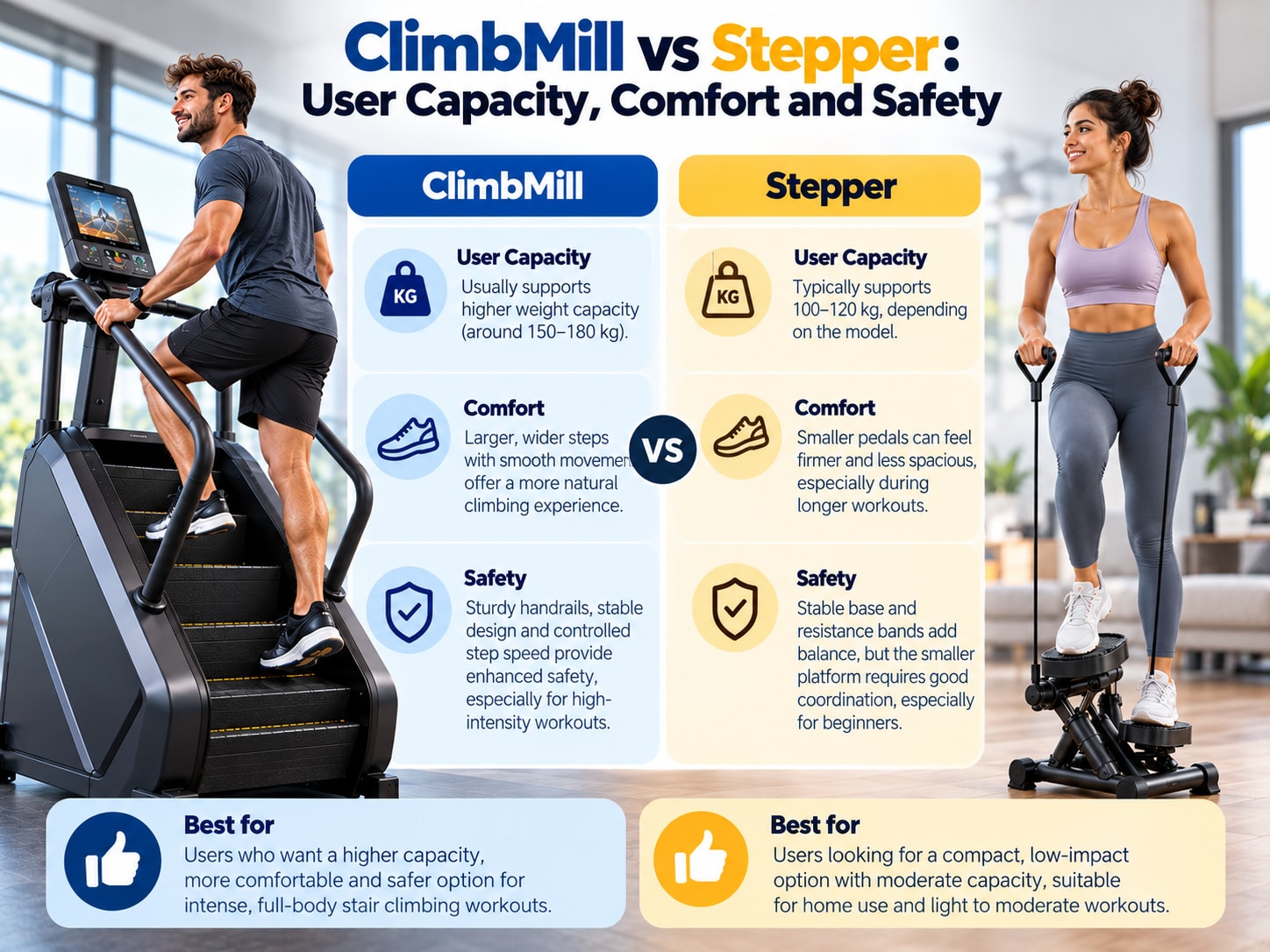
ClimbMill vs Stepper: User Capacity, Comfort and Safety
User capacity is another important factor, particularly when choosing equipment for a commercial gym. Every machine has a specified maximum user weight. This limit varies by model, so it is important to check the manufacturer's specifications rather than relying on the machine category alone.
User capacity for ClimbMills
Commercial ClimbMills are designed for repeated use, but their user-weight limits and intended usage vary. Check the maximum user weight, stability, step dimensions, handrail design, and warranty terms.
If the machine will be used throughout the day in a busy gym, confirm that its construction and service support match the expected usage.
User capacity for steppers
Compact home steppers can have different weight limits from commercial stair-climbing machines. Check the manufacturer's stated maximum user weight and ensure that the machine is suitable for the people who will use it.
Look at pedal size, grip, stability, and resistance controls. Users should be able to maintain a comfortable stepping rhythm without feeling that the equipment is unstable.
Safety features to look for
Depending on the model, useful features may include the following aspects:
Secure handrails or handles.
Non-slip steps or pedals.
Clear speed or resistance controls.
An easy-to-read display.
Emergency stop features, where provided.
A stable frame and suitable user-weight rating.
Users should start at a comfortable pace, hold the handrails when needed, and avoid leaning heavily on them throughout the workout. Anyone with balance difficulties, joint concerns, or relevant medical restrictions should seek appropriate professional advice before using a challenging stair-climbing machine.
Home Gym vs Commercial Gym: Which Machine Fits Better?
The right choice depends on how the equipment will be used and who will use it.
Home gyms
For a home gym, a compact stepper can be a practical option, if you want regular cardio without giving up too much floor space. It may suit an apartment, spare room, or compact workout area.
A ClimbMill may be worth considering, if you have a dedicated home gym, enough ceiling height, and a preference for continuous stair climbing. Before investing, consider the purchase price, power requirements, delivery access, maintenance, and available service support.
In the GCC countries, it is advisable to check the equipment's availability and delivery arrangements before placing an order.
Commercial gyms and fitness clubs
A ClimbMill can be a strong addition to a commercial cardio zone. It offers a distinct workout option alongside treadmills, ellipticals, exercise bikes, and rowing machines.
It may be especially suitable for premium gyms, hotel fitness centres, and facilities where members expect a wide choice of cardio equipment.
Commercial steppers can also be useful, but the right model depends on the intended workout and the facility's needs. A compact home-use stepper may not be suitable for a busy gym with frequent daily use.
Personal training studios
A personal training studio should consider both the available space and the range of clients it serves. A compact stepper may work well for general cardio sessions and warm-ups, depending on the model.
A ClimbMill may suit studios that focus on endurance, conditioning, or more challenging cardio sessions. However, the trainer should ensure that the machine is appropriate for the client's fitness level and movement ability.
Hotels and residential fitness facilities
Hotels and residential gyms need equipment that is easy to understand, reliable, and suitable for a wide range of users. A ClimbMill can add variety to a larger cardio area, while a smaller stepper may be useful where space is restricted.
For shared facilities, consider factors like cleaning, routine inspection, maintenance access, and the availability of replacement parts.
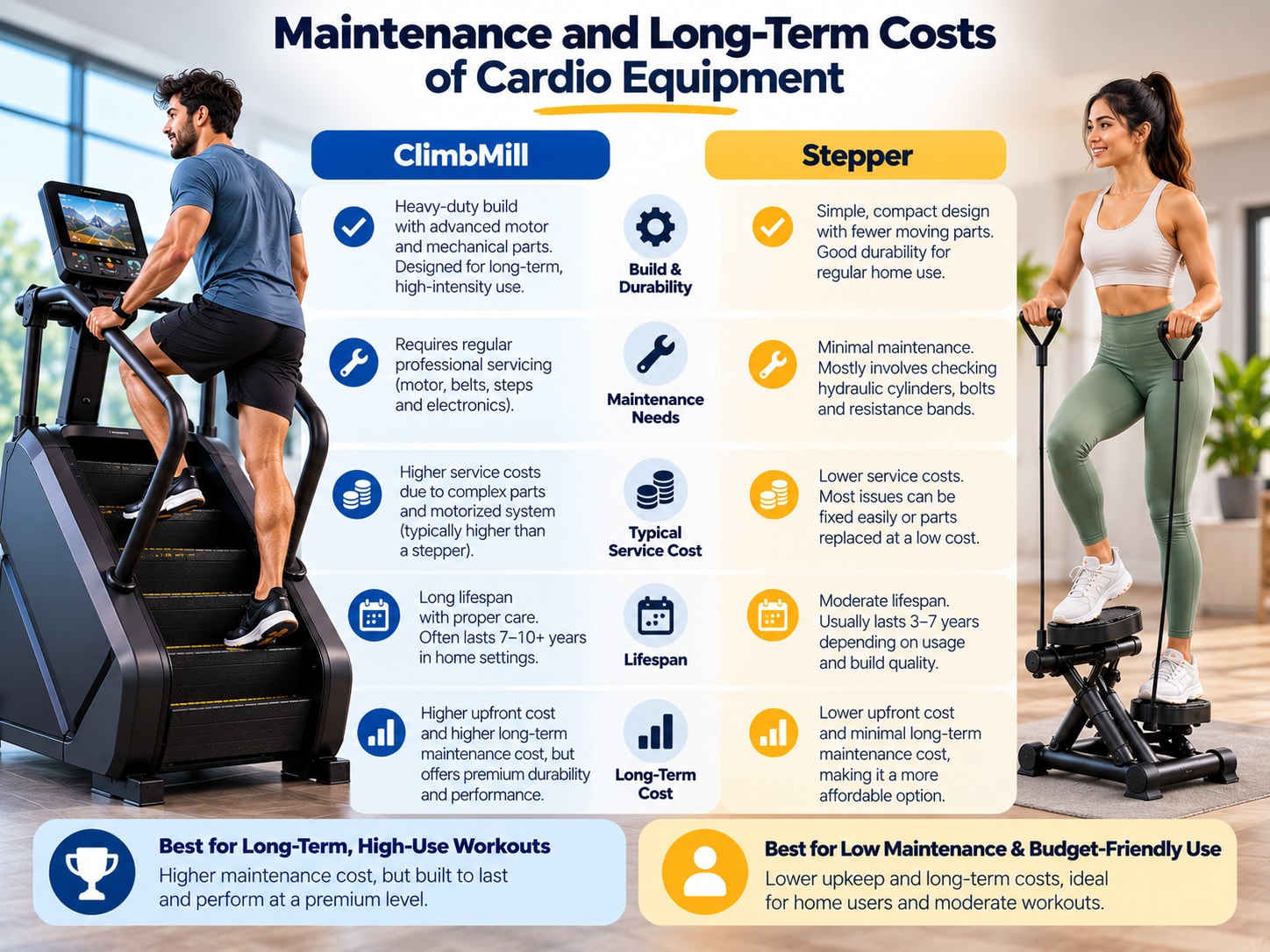
Maintenance and Long-Term Costs of Cardio Equipment
The purchase price is only one part of the total cost of owning cardio equipment. Maintenance, repairs, spare parts, electricity, and downtime may also affect the overall value.
A ClimbMill has moving steps and a drive system that require inspection and servicing according to the manufacturer's recommendations. Regular checks help identify wear, unusual noises, loose components, and other issues before they become bigger problems.
A stepper's maintenance needs depend on its design. Compact models may have fewer complex components, while commercial machines can have more substantial mechanical and electronic systems.
Dust can collect around equipment, while frequent use in shared gyms can increase wear. Air conditioning helps maintain a comfortable workout environment, but equipment should still be cleaned and maintained correctly.
For both machine types, consider the following tips:
Wipe down contact surfaces after use.
Keep the surrounding area clean and free of obstructions.
Inspect steps, pedals, handles, and visible fasteners.
Report unusual noises or changes in movement.
Follow the manufacturer's cleaning and servicing instructions.
Arrange professional servicing when required.
Commercial facilities should consider a preventive maintenance schedule and confirm the availability of local service support and spare parts.
What Should You Check Before Buying a ClimbMill or Stepper?
Before choosing a machine, compare the specifications and intended use rather than relying on the product name alone. Use this checklist to make a more informed decision.
Movement type: Does the machine use continuous rotating stairs or separate up-and-down pedals?
Workout settings: Check speed, resistance levels, workout programmes, and heart-rate features, where available.
Dimensions: Measure the room, access route, ceiling height, and required clearance.
User capacity: Confirm the manufacturer's maximum user-weight rating.
Intended use: Check whether the model is designed for home use, light shared use, or commercial operation.
Comfort and safety: Examine handrails, step or pedal size, grip, stability, and ease of mounting.
Delivery and installation: Confirm delivery coverage, installation arrangements, and access requirements in your location.
Maintenance and warranty: Review warranty coverage, recommended servicing, spare-parts availability, and local service support.
Total budget: Include delivery, installation, maintenance, and any additional costs in your budget.
Try before buying: If possible, test the machine to see whether the movement feels comfortable and natural.
People across Kuwait may visit Lifetime Fitness Store to experience premium fitness equipment, exceptional customer service, seamless delivery, and a world-class shopping experience, all under one roof!
Conclusion
The ClimbMill vs stepper decision comes down to your workout preferences, available space, budget, and intended users.
Choose a ClimbMill if you want a continuous stair-climbing workout, a challenging cardio option, and a dedicated machine for a commercial gym or spacious home gym.
Choose a compact stepper if you need a smaller cardio machine for an apartment, villa, or personal workout area. It can be a practical choice for regular stepping workouts without the footprint of a full-sized ClimbMill.
For commercial facilities, always check the model's user-weight rating, durability, intended usage, warranty, and service support before making a purchase. There is no single best machine for everyone. The right choice is the one that fits your space, supports your fitness goals, and encourages consistent exercise.
A ClimbMill features continuously rotating stairs that simulate climbing a staircase, while a stepper uses pedals or steps to mimic stepping movements. ClimbMills generally provide a more demanding full-body cardio workout, whereas steppers are often more compact and suitable for home gyms.
Both machines can support weight loss by burning calories and improving cardiovascular fitness. A ClimbMill typically offers a more intense workout, while a stepper can provide effective calorie-burning sessions at a manageable intensity. The best choice depends on your fitness level, workout duration, and consistency.
A stepper generally takes up less floor space, making it a practical option for home gyms and smaller workout areas. A ClimbMill is typically larger and taller, requiring more room for the machine, safe access, and comfortable use.
Choose a ClimbMill if you want high-intensity cardio, a challenging stair-climbing workout, and commercial gym functionality. A stepper is a better option if you prioritize compact design, affordability, and convenient everyday workouts. Consider your budget, available space, target users, and fitness goals before purchasing.






 Get a weekly dose of latest stories
and useful tips directly in your inbox!


 0







































 Price Match Guarantee
 Free Shipping
 Product Warranty
 After-Sale Support
 Have Coupon Code?
 You'll Save 0.00 On This Order
 Safe And Secure Payments. Easy Returns. 100% Genuine Products